|
|
Get solar electric panels and save up to 50% on your monthly electric bill. |
||||||||||||||||||||||||||||||||||||||||
|---|---|---|---|---|---|---|---|---|---|---|---|---|---|---|---|---|---|---|---|---|---|---|---|---|---|---|---|---|---|---|---|---|---|---|---|---|---|---|---|---|---|
|
You may be able to install solar panels at your residence and significantly reduce your monthly electric bill, locking in a low utility rate using the sun, a clean green power source. I created this site after doing research to satisfy my own skepticism. The result was reducing my electric bill in half with $0 investment cost and a fully warranted system, no hassle, no maintencance solar power system. I'm excited to share the answers to frequently asked questions in this web page. Simply fill in the following form for a free solar assessment showing your monthly savings. I have negotiated discounts with several companies to get installation reduction coupons and an additional $100 in savings. The following information in the form is needed to do a feasibility analysis of your location and to contact you. Does solar make sense, this FAQ and Howto guide is intended to provide you with information to assist you in making a decision as to whether or not a solar pv system is the right choice for your energy needs and if it offers the potential for a more economical source of electric power. It will raise issues, discuss options, and educate you prior to contacting a residential or commercial solar installation representative who will then guide you on the specifics for your location and power requirements. Don't be overwhelmed by all the information I have provided in this document. You have probably heard and read about solar panels for residential use but you may not know you can now install it on your home with no cost and save on your electric bill. I recommend you lease a solar system rather than purchase one and you can see why in the information I have provided. I had previously created the site how to read your Itron Centron digital electric meter down to the Watt-hour and analyze your electric usage. This seemed like the next logical step from understanding your consumption, to finding ways to reduce cost, generate electricity using green technology, and analyzing Solar PV (PhotoVoltaic) Systems ROI to help you in deciding if residential solar power via renewable energy technology is right for your home. I was surprised to see how much I could negotiate price and that with no money down I could reduce my electric bill by almost 50%. Get some great information from our friends at Evergreen Solar - the National Council for Solar Growth, a non-profit We are like tenant farmers chopping down the fence around our house for fuel when we should be using Nature's inexhaustible sources of energy -- sun, wind and tide. ... I'd put my money on the sun and solar energy. What a source of power! I hope we don't have to wait until oil and coal run out before we tackle that. -Thomas Edison, inventor (1847-1931) FAQ Table of Contents
Solar Deals on PhotoVoltaic Panel systems with analysis on ROI and recommendations on lease, loan, buy, discounts, rebates, referrals, and reference links.Understanding your location geographically and on your roofThere is a great site to see what your expected production can be based on your geographic location and facing, PVWatts Version 2 NREL performance calculator for Grid-Connected PV Systems. Google has recently created Google Project Sunroof that uses this NREL data for seasonal production and satelite imagery to calculate roof space and solar shade. This tool creates a good first step to understanding your possible production/solar potential. For North America, south facing, which is 180 degrees, would be the best location, followed by east or west with north facing being the worst. A 40 degree roof tilt angle on a south facing roof would be about optimal. In the table below, see some computations using Boulder, CO as an example. You will notice that tilt angle is pretty forgiving and if you have a roof that is 45 degrees off of south you still do better than facing east or west. Optimal is a 2-way tilt tracking system that follows the sun but only makes sense for a ground installed system, not on a roof since full tilt is not feasible and only minor adjustments are possible. The solar radiation (insulation) numbers below tell you the how much production your system will produce on average during a year. The larger the number the higher your production and the cheaper the electricity production will be for your system. For example: A 2.5 insulation number would produce half the amount of a 5 insulation number and therefore require twice as many panels to produce the same amount of electricity.
|
|
||||||||||||||||||||||||||||||||||||||||
Effect on home owner insurance ratesEach insurance company handles solar installation differently so contact your insurance agent. If you lease the system, the leasing company will most likely cover the insurance as it is not considered part of the structure of your home. More details later on leasing vs. buying. Systems can range from $30K-$55K and the insured value is based on the replacement cost which is the full value before rebates. Some insurance companies have no additional fees for solar installations but others might. For example, Xcel Energy Solar*Rewards Small Program (0.5kW to 10.0kW) requires that homeowners with residential solar panels have a minimum insurance of $300K. If you have a home insured for $100K you would need to add an additional $200K of insurance to meet the minimum. If you are lucky enough to have a home worth over $300K then you only need to be concerned about insuring the system and not the minimum insurance issue. To give an example of insurance rates where no minimum is required, a $240K policy costing $545 per year would cost $585 with a $30K system and $653 with a $60K system. That is a cost of $110 every year and will rise with inflation. Cost of systems and ROIThe cost of a system should be relatively constant. Price changes in panels and rebates will have an impact on your purchase price. Below are some key bullets that affect your ROI (return on investment).
Lease vs. Buying (20 year comparison)
Choosing panelsThere are many brands to choose from and other sites cover these issues in the solar renewable energy technology. The simple analysis is price vs. performance. Less expensive panels have lower production and therefore require more panels. You need to take into consideration which panels offer the best price per square foot of space. Your roof size will also play a factor. If you don't have enough roof surface area to meet your production goals a more expensive panel per square foot might be a better option in the long run. Often the lease option will be better for the higher efficiency panels while buying might be more economical for lower efficiency panels. Panels come in various sizes to fit your space and to resolve configuration issues. For example, the e19 comes in 240w (72 cells), 320w (96 cells), 425w (128 cells) Below is some information on SunPower which has their own leasing division providing you with the option to buy or lease their products. They also have various efficiency levels to choose from. SunPower is currently the leader in efficiency but again explore different brands and sites that go into more detail on this topic. See rebates and referrals section to save on SunPower panels. A number commonly quoted is 120Sq ft. (10ft x12ft) per
1Kw which is an efficiency of 9.0%. Note cell sizes are not the same across brands (so that info is kind of useless for comparison across brands but may be useful within brand comparison, for example the SunPower e18, e19, e20)
SunPower Panelse20 - 327w - 20.1%
efficiency - 96 cells (22.5% cell efficiency)- 3.406w per cell - for 120sq/ft. (2.242 kW) (SPR-327NE-WHT-D) The following are 3 models of SunPower panels and their
production.
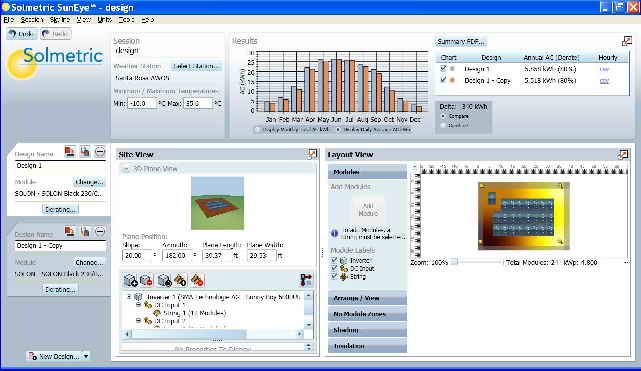
Sanyo PanelsHIT Power 215N - 215 Watt - 17.1% efficiency - 72 cells (19.3% cell efficiency) 2.986w per cell - for 120sq/ft. (1.902 kW) Yingli Solar PanelsYL240P-29b - YGE 240 Series - 240 Watt - 14.7% efficiency - 60 cells - 4w per cell - for 120sq/ft. (1.638kW) Kyocera PanelsKD215GX-LPU - KD 200-54 P Series - 215 Watt - 14.5% efficiency - 54 cells - 3.981w per cell - for 120sq/ft. (1.612 kW) Grape Solar PanelsGrape Solar CS-P-230-DJ - 230 Watt - 14.1% efficiency - 60 cells (17.0% cell efficiency) 3.833w per cell - for 120sq/ft. (1.573 kW) How it works: Inverters and Micro-invertersA very short and quick version. Solar photovoltaic panels generate DC (Direct Current) which can be stored to batteries but needs to be converted to AC (Alternating Current) for use in your home and to send back out over the electric grid. The inverter is essentially a power adapter that converts DC to AC and changes the voltage. DC flows in only one direction while the AC, like its name, alternates direction. The inverter takes 12, 24, 48 volts DC and in North America converts it to 120, 240 volts AC at 60 Hertz (cycles per second). These inverters are highly sophisticated and must handle inputs voltages that vary widely based on battery state and production variations of the solar panels. The inverters must also handle output demands based on widely varied utilization - a few lights to running a hot tub and an air conditioning system - while maintaining AC quality within narrow constraints and efficiently with minimal power loss. Micro-inverters are attached to each panel to convert the DC to AC. They are said to last longer and not need replacement every ~10 years like an inverter. They also allow maximum production per panel. Inverters are designed in lines with multiple panels placed on each line. Each line needs to have the same number of panels or watts connected to them therefore requiring more fun math when designing a system. A common system might have 4 strings/lines with 6 panels per line. Another issue is energy production per line can be no higher than the weakest link; all other panels will decrease production to match the lowest producer. The lowest producer may be a permanently degraded panel or a panel temporarily degraded from environmental factors (dust, leaves, bird, squirrel, snow, shadow from a passing cloud). You might find that a tree, roof, or other obstruction creates shade during certain times of the day based on the sun's location which will reduce the production An advantage and disadvantage of inverters is one point of failure. If the inverter dies your system goes down but on the positive side, there is just one point for replacement and access vs. each panel. And it should be noted inverters fail without any warning. Layout toolsThere are many tools on the market to assist you in designing your system, choosing the right panels (physical size, watts), number of panels, inverters, roof layout, and more. The following are some tools that designers might use to improve production by identifying obstructions and using the results to produce the most efficient layout and string configurations. This is good information for you to understand how things work but less important if you are not an installer or doing the install yourself. SolmetricSolmetric has created a suite of products to assist in the layout of your system. They have the SunEye that will show you obstructions at various places on your roof caused by trees, adjacent roofs, etc. It is similar to the inexpensive fisheye globe with markers for time of day and time of year with the addition of a digital camera, GPS, and compass to collect pictures and data for future analysis. The Design software takes the shade information and uses it for analysis taking into account seasonal blossoming of the trees, PVWatts data, etc. They also have an iSV iPhone solar app which is less accurate but lets you make initial estimates for just $5. Sample image from the Solmetric SunEye 210 Shade Tool ~$2,000
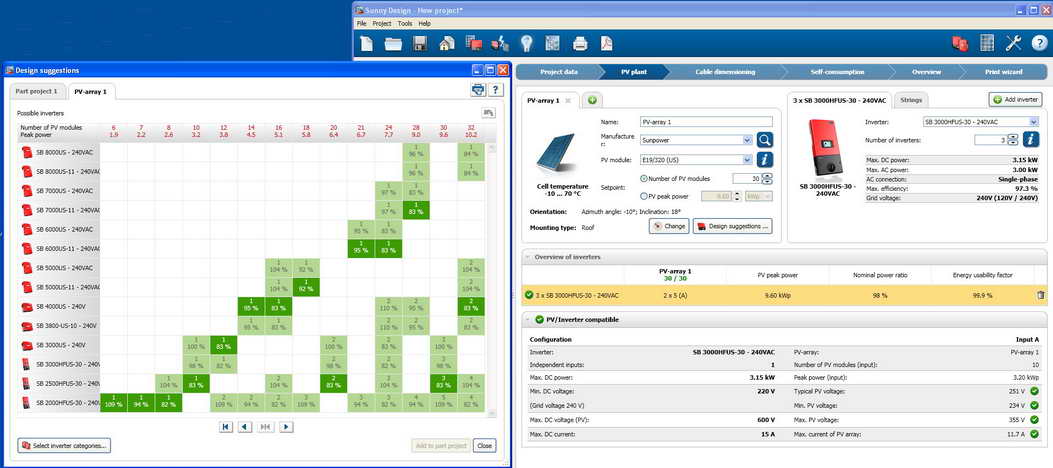
Sample image from the Solmetirc SunEye PV Designer software ~$400 per year Sunny DesignHere is another application to help with configuration from SMA Solar Technology which is one of the major producers of inverter technology. Their design tool is free with the idea their tool will help you make better use of their products. It is very simple and does not help with location layout but does help with analysis of wiring and string breakdown. Sample image from the SMA Sunny Design 2.0 software tool that is free Batteries vs. Electric GridI won't go into this in detail and here is the simple version. Batteries are not currently economical enough to consider for energy production and the environmental impact for replacement, manufacturing, and disposal is yet to be seen. They do make sense for those who are in locations where the electric grid is unavailable or for other reasons one might have to be off the electric grid. If the grid goes down you will still have power if you are not connected and have your batteries. Those on the grid will loose power even if their system is functioning since a safety mechanism shuts off production when the grid goes down to prevent sending electricity over the grid. This is necessary to allow maintenance work to fix issues without fear of being electrocuted by your generator. For most, batteries are not used and instead being grid-connected allows for using the grid as an external battery to send excess during over production hours and a location to get electricity during under production times. How this works is based on individual states. Some states allow electric companies to charge a fee for sending your excess electric out over their power grid lines and a fee when retrieving electricity from the grid. Other states like Colorado allow for net metering which only has fees for sum total of flows. In these cases, if your meter is zero after a month or specified billing period, you don't pay for all those transmissions. A few final notes. If you under produce you must buy from the electric company the extra amount needed to fulfill your electrical needs. If you over produce they will buy it from you but at approximately 1/3 of what you pay since they pay wholesale prices. Lastly, there is usually a minimal fee for being on the grid. For example, Xcel charges about $8 (with tax) to be connected to the electrical grid. Energy Monitoring SolutionsTrack your energy consumption and solar energy production via your computer with nice graphs. I have listed some hardware devices for comparison and many software solutions exist that make use of the data from these systems. They are all pretty simple and similar. They provide instantaneous consumption and production monitoring known as power (measured in kW) and time based information known as energy (power over time measured in kWh). Data is collected by placing monitoring probes around the cables and data can be collected from the magnetic field disturbance generated around the cables. For under $500 you can track production and utilization of your entire home and even sub-circuits. Google
PowerMeter Software which was retired in 2011. Using eGaugeThe eGauge system
is a company in Boulder, CO. Using TED 5000The Energy
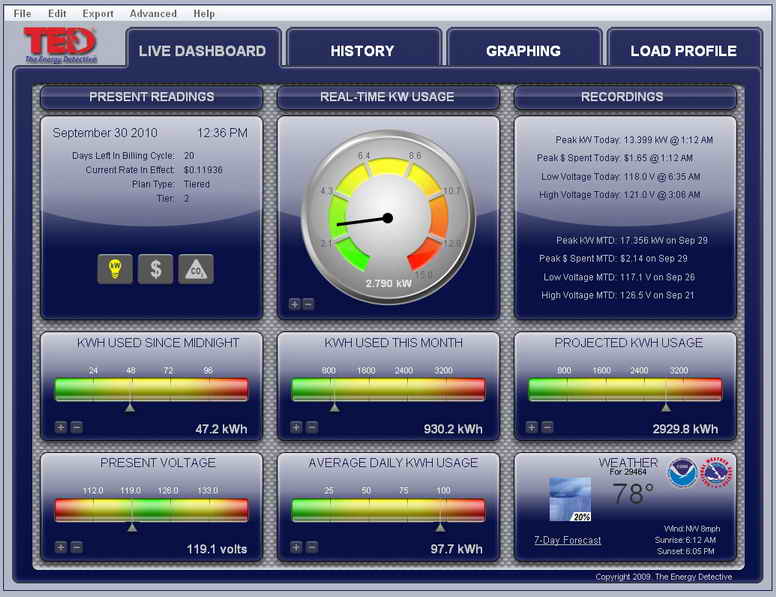
Detective 5000 from Energy, Inc., a Charleston, S.C. company, is
a nice monitoring system focusing on the lower price point and has received major funding from 3M. Their system can handle up to 4 Current Transformers (CTs) to monitor 4 sources (power production, consumption, specific circuits, etc.). Using Advanced Pulse WattNode - Continental Control SystemsSunPower rebrands the Advanced Pulse WattNode by Continental Control Systems. You can see an overview of the various WattNode products which are geared toward the lower price point market. Very low on features, basic consumption and production monitoring. This company is located in Boulder, CO.
Some information on SunPower's offering Rebates, Coupons, Free assessmentsFor reference links to the various government and utility company rebates and tax credits you can check out their websites. DSIRE (Database of State Incentives for Renewables & Efficiency) is a good site for links to the federal, state, local, and energy company programs. With the leasing option most of these don't apply but it is always worth investigating since there are exceptions. For example, Colorado (see Recharge Colorado) has an energy monitoring credit that applies even for leased systems. I have contacted the following companies and setup referral programs so you can save additional funds on your installs of solar panel systems. Based on my research, I have selected companies that seem reputable and good to work with. I make no guarantee as to their service, especially installers, as they have many offices and employees and your experience may vary. I am stating this to provide full disclosure and help you make your own decision. You should expect the process to take 2-3 months from getting your free solar assessment to installation, connection to the grid, and start of operation. In coming months I will add additional companies to the list of choices. I have currently only listed SunPower panels but will add other manufacturers in the near future as well. I do like and have myself tried SunPower's new lease deal installed by Real Goods Solar that allowed me to have ROI day one (based on my geographic location, roof facing, obstructions, etc). Send me information about companies you have had good experiences with so I can spread the word. Wondering how I was able to get you these referral discounts? A document from SunRun estimates marketing costs of $2,500 per system and these companies are saving that money by having me educate and send them customers. Here are the current great solar deals and referral fees as of April 2013. They may change without notice at any time which is why I make no guarantees.
Fill in the following form and select the companies to contact you for a free solar assessment. If you purchase or lease a system you will be doing a great part in helping with green energy, reduce your electric bill, and also get some extra money back. |
|||||||||||||||||||||||||||||||||||||||||
|
|
|||||||||||||||||||||||||||||||||||||||||